PFAS contamination update: RAF Upper Heyford and Heyford Park
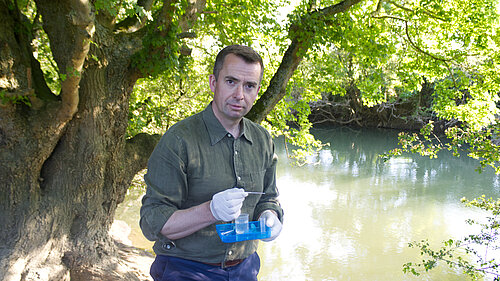
PFAS contamination update: RAF Upper Heyford and Heyford Park
On 30 April, I attended a public meeting in Upper Heyford, bringing together local residents, environmental activists, environmental scientists and elected representatives.
It was an urgent wake-up call. The evidence presented on the level of contamination by forever chemicals (PFAS) in Gallos Brook, the hard reality that these are extremely hard to remove or remediate, and some worrying examples of human and animal sickness gave us all cause for concern. Like many others present, I was shocked by what I heard and keen to acquire more knowledge and evidence to answer a series of questions.
I wrote immediately to Ministers, regulators and public bodies for answers. Since then, I took the chance to raise PFAS contamination at Prime Minister’s Questions (PMQs) on 20 May.
At PMQs, Keir Starmer agreed that a meeting should take place with the relevant Secretaries of State. I have written to both the Health Secretary and the Environment Secretary to request that meeting and we are continuing to press for it to be arranged. We are also in the process of setting up a meeting with Emma Hardy MP, the Minister responsible for PFAS, but are clear this cannot be a substitute for the joined-up meeting with both Secretaries of State that residents were promised.
This issue cuts across health, the environment, planning, water quality and the legacy of RAF Upper Heyford’s military use. Residents should not have to navigate different public bodies passing responsibility between one another. There needs to be one coordinated response from central Government.
I have written to a series of public bodies to seek answers about what is known, what testing has taken place and what further action is now needed. These include the Ministry of Defence, the Environment Agency, Cherwell District Council, the Department for Education, the UK Health Security Agency and the Drinking Water Inspectorate.
The most significant response so far has come from the Ministry of Defence, which has sent a large number of historic documents relating to RAF Upper Heyford. My team and I have started reviewing these documents and I intend to publish them so residents can see the evidence for themselves.
The documents do not prove PFAS contamination at RAF Upper Heyford. However, they do raise serious issues, such as:
MOD has confirmed that PFAS was not tested for in the historic Land Quality Assessments, because those checks were not carried out at the time (20260605-EIR2026_09271.pdf, pp.2-3).
The ministerial response also says the site was disposed of in the mid-1990s before any form of PFAS testing began, that MOD holds no records of PFAS contamination at the site and that MOD has not been involved in subsequent monitoring or engagement with regulators (MC2026_09251 Calum Miller MP.pdf, p.1)
Historic MOD documents identified the “Adjacent Fire Practice Pond” and associated building as a potential contamination source, with possible contaminants including petroleum, oil and lubricants, solvents and fire-fighting chemicals (Annex A_Redacted (1).pdf, p.25).
The same document says the fire pond area drained to storm water drainage (Annex A_Redacted (1).pdf, p.25), while another report confirms that the Fire Practice Pond was the only known burning ground area at RAF Upper Heyford (Annex H_Redacted_Redacted.pdf, p.43)
One report says the site represented a “potentially serious risk to the environment” because of historic activities, the major aquifer and nearby potable supply abstractors. It also says off-site impacts may already have occurred, although no documented impacts were known at the time (Annex A_Redacted (1).pdf, p.9).
MOD’s own consultants set out two options: remove contaminated soils from various areas, or provide all available information to potential developers so contaminants could be addressed through redevelopment plans. The recommendation was that MOD follow the second option (Annex D_Redacted.pdf, p.41).
One report also recommended regular groundwater quality monitoring throughout redevelopment (Annex G_Redacted (1)_Redacted.pdf, p.7).
Taken together, the documents show that historic contamination risks were identified, including fire-fighting chemicals, a fire practice pond, storm water drainage and vulnerable groundwater pathways. But PFAS was not tested for. MOD now says it holds no PFAS records and has not been involved in subsequent monitoring.
I can understand why this decision may have been taken then. But, knowing the dangers of PFAS, that line cannot hold. These documents show enough to justify urgent, PFAS-specific testing and much clearer public accountability.
The responses from other public bodies also show why a coordinated response is needed.
UKHSA has said that it advises Government departments and agencies on public health risks from environmental exposure to PFAS, but that it has no regulatory powers to address contaminated land. Its response points to local authorities as the bodies responsible for identifying and dealing with unacceptable risks to public health and the environment. I do not think this provides the site-specific clarity residents need, so I will be writing again to press for fuller public health engagement. At the same time, I am asking Cherwell District Council to review its responsibilities in respect of the site and to work with the Environment Agency to agree a suitable testing and monitoring regime for water and soil quality.
According to Cherwell District Council’s PFAS information page, drinking water at Upper Heyford is supplied by Thames Water via the mains network, not from private or local water supplies.However, in light of MOD evidence, I have also recently written to the Drinking Water Inspectorate to seek clarity on drinking water supplies in Upper Heyford and the surrounding area, including whether properties are supplied through the public mains water network, what PFAS monitoring arrangements are in place and whether the DWI has any concerns about mains drinking water safety locally.
I recently met with a senior regional official for the Environment Agency, which has confirmed that it will convene a working group of key partners to coordinate the response. I will also meet with an Environment Agency PFAS expert ahead of my ministerial meetings.
Disappointingly, the Department for Education has failed to provide a response to my letter, which I am now chasing.
The key questions I am now pursuing are:
- What testing has the Environment Agency carried out so far and what further testing is planned?
- Will the fire practice pond area, groundwater, surface water, springs, brooks and drainage pathways be tested specifically for PFAS?
- What soil testing has been carried out by Cherwell District Council, developers, landowners or consultants?
- Did MOD pass all relevant contamination information to developers or purchasers, as its consultants recommended?
- Who was responsible for ensuring contamination was addressed during redevelopment?
- What records exist on the use of fire-fighting foams, AFFF, fire training, spills and disposal at RAF Upper Heyford?
- When did the US Air Force and its suppliers of fire-fighting foams become aware of the potential presence of PFAS in those products?
- What role should public health officials now play?
- What hydrological or hydrogeological advice is needed to understand how water moves beneath and away from the former airbase?
I will continue pressing for the promised meeting with the Health Secretary and Environment Secretary, while also progressing the meeting with Emma Hardy MP. I will also continue to press MOD, the Environment Agency, Cherwell District Council, UKHSA, the Drinking Water Inspectorate and other relevant bodies for answers.
Residents deserve proper testing, proper transparency and a coordinated response that treats this issue with the seriousness it deserves.