MP calls on Government to come clean on costs of asylum centre before signing contracts
MP calls on Government to come clean on costs of asylum centre before signing contracts
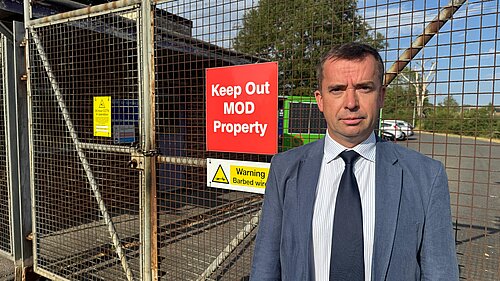
As first reported in ‘The Times’ (28 September), Calum Miller, MP for Bicester and Woodstock, has called on Government ministers to come clean about the costs of the proposed asylum centre at MOD Bicester, near to Piddington and other local villages.
The proposed asylum centre would be built on an area of the MOD site previously used to store military equipment. It has never had residential accommodation. Calum Miller uses previously published costs for asylum accommodation at MOD Bicester to estimate that establishing the site could cost more than £250 million – or nearly £200,000 for each bed in the facility – while the 10 year total cost could exceed £1 billion. He is calling for the Government to set out the full costs for the project and ensure these are subjected to a rigorous value-for-money assessment by the Home Office and Treasury before any contracts are signed.
Calum Miller said:
“Housing over 1250 asylum seekers at MOD Bicester is the wrong plan for local communities, asylum seekers and the taxpayer. This is a site with no facilities: no accommodation, no power, no water, no safe transport. It also has a series of buildings riddled with asbestos and may have unexploded munitions.
“This is not a plan to put asylum seekers in existing MOD accommodation; it is a plan to build brand-new asylum-seeker accommodation on MOD land. The cost of setting this up could be over £250 million while the total cost over 10 years could top £1 billion.
“Before the Government spends nearly £200,000 just to put each bed in the camp, it should stop and think. That money could be much better used to tackle the asylum backlog and bring down the number of people waiting for a decision.
“The Home Affairs Select Committee and the National Audit Office have previously warned the Government that it has wasted millions on asylum accommodation by rushing ahead. At a time when all public services are under financial pressure, I am calling on Ministers to set out the business case and justify the costs to taxpayers before they issue any contracts for this project.”
Background
The Home Office’s planning application sets out a series of costly challenges in converting the site to house asylum seekers:
- A derelict site: “The site has been unmaintained and is heavily overgrown with vegetation”. [Transport Assessment]
- No accommodation units: “the Proposed Development comprises the demolition of existing buildings and structures, the erection of new modular accommodation” [Planning Application]
- No electricity supply: “the condition, capacity and configuration of this network are currently unknown”, so “the current proposal assumes that the existing electoral infrastructure cannot be relied upon, and therefore temporary and/or permanent generator provision shall be incorporated to support the development”. [Utilities and Infrastructure Assessment]
- No clean water supply: “allowance for potable water storage is planned”. [Utilities and Infrastructure Assessment]
- No waste water connection: “a new on-site treatment works with discharge to watercourse, has been assumed for the purposes of the current strategy” [Utilities and Infrastructure Assessment]
- High voltage cables: “The site is intersected by existing high voltage overhead lines” [Utilities and Infrastructure Assessment]
- Pre-existing buildings with asbestos: “The majority of the existing buildings onsite, particularly the large warehouses, contain asbestos and are deemed to be dangerous, unstable structures and require demolition.” [Transport Assessment]
- Potential unexploded ordnance: “This cannot be discounted at this stage, and further research is warranted to ascertain more details relating to any potential association with munitions.” [Unexploded ordnance risk assessment]
- No safe walking routes: “There is currently no pedestrian infrastructure provided along this section of the B4011” [Utilities and Infrastructure Assessment]
These challenges are reflected in the likely cost of making the site usable. The Government has not given a figure for this, but historic figures give a guide. Back in 2003, the Government planned to use the site to house 750 asylum seekers. The capital cost was put at £87.7m in 2005 by the NAO. Scaling this up to 1256 beds, the cost would have been £146.9m in 2005 prices. With inflation (applying CPI), that would be a cost of £269.7m in 2026 prices. That is a conservative estimated since construction CPI has run above whole economy CPI. (The ONS construction inflation index shows this to have been 50% cumulatively from 2014-2026 compared to 43.5% for CPI.)
Whole-life-cycle costs are estimated from the figures from the NAO report into asylum accommodation. It shows that the estimated annual costs of Wethersfield (800 occupants) was £63.3m and Scampton (2000 occupants) was £116.3m. This translates to £79.1k per bed and £58.2k per bed respectively – a mean of £68.7k. For the 1256 beds at MOD Bicester, that would amount to £86.2m.
The risks of using taxpayer funds poorly for this project have been highlighted by past mistakes. Back in 2001-5, the Government planned to use the same site at MOD Bicester to house 750 asylum seekers. It eventually cancelled the programme. A highly critical National Audit Office (NAO) report in 2007 identified that £28 million had been wasted on the abortive scheme and highlighted “[the risk] to project management, such as delays, higher costs and falling benefits”.
In a 2025 report on asylum accommodation , the Home Affairs Select Committee (HASC) commented directly on the use of larger sites (such as MOD Bicester) [emphasis added]: “The department is considering the use of large sites in its approach to asylum accommodation, having previously said it would move away from their use. In principle, large sites can provide suitable temporary accommodation. However, they have generally proved more costly to deliver than hotel accommodation and will not enable the department to drive down costs in the same way as expanding Dispersal Accommodation. If the department chooses to pursue large sites, it needs to fully understand and accept this trade off. It must learn the lessons from its previous mistakes in rushing to deliver short-term solutions that later unravel.” The HASC report went onto identify that the Home Office initially estimated the cost of setting up the asylum centre at Wethersfield (reusing existing accommodation and for many fewer beds than at Bicester) to be £5m but that it cost £49m in the end.
Calum Miller met with Asylum and Borders Minister, Anna Turley, and Home Office officials on 14 September and they assured him that no contracts had yet been issued for the site, pending planning permission. This was confirmed in an answer from Anna Turley to Calum Miller’s written question on 17 September:
“No decision has been made in respect of the use of MoD Bicester for asylum accommodation. Due diligence and assurance work for all proposed large sites including Bicester is still ongoing. This includes assessing accurate costings. Once complete, business cases and approvals will be sought and details published in the normal way for all Major Government Programmes.” At the same meeting, Calum requested that the procurement process should be published so it can be scrutinised by members of parliament and the public. Calum wrote on 24 September to Anna Turley to request that the Home Office set out the estimated costs of the asylum centre at MOD Bicester, that it commits to publish the full business case (including costings) before a final decision and that it submits the project to the National Infrastructure and Service Transformation Authority (NISTA) as a mega project.
Calum Miller worked as a senior civil servant at the Treasury from 1999-2009. From 2006-09 he led a public expenditure team responsible for agreeing and tracking departmental budgets.